Yesterday, I saw a maple tree laughing leaves. Or was it crying?
Sometimes, it can be difficult to tell the difference between the work of our joy and that of our sorrow. This, I am realizing, is where our resilience can be born.
Perhaps because both laughter and tears are so near in the depth of things, like the passing time and strong permanence, we can uncover profound truths in those places where such supposed opposites meet, only to reveal how they are kindred. Early autumn matches my heart as leaves take flight against blue skies, holding both tender sorrow and riotous hope at the very same moment. Before I had words for that maple tree, a sigh slipped out between my lips.
What’s the world for that mixed emotion – bittersweet, poignant, melancholy, wistful? The Japanese have a phrase for the beautiful sadness of things, the ah-ness of things. Mono no aware is the quiet sigh as something precious fades or scatters to the wind. It includes common moods experienced in falling petals and turning leaves, passing seasons, birdsong, phases of the moon, and missing those we love.
I feel the aha-ness of things every fall. And I felt it more pointedly a few weeks ago while standing with Mike at his father’s grave at Arlington National Cemetery. We held hands and remembered Hank’s visits to our home, how he sipped black coffee and read the paper newspaper (it bears repeating) in button-up pajamas and matching robe, eating toast and jam with our youngest daughter on his lap. He called her Teacup.
At his military funeral in October 2011, you could see the Pentagon in full view from his gravesite, including the still smoldering hole from American Airlines flight 77. Now, Hank has been gone 25 years, Teacup is a mama to her own three little people, and there are different holes in the Pentagon. Now, some 10,000 trees shade the cemetery, his grave, and our view of the Pentagon, bearing witness to the ache of missing Hank and the persistent passing of time.
At dusk the night before, after moonrise over the rotunda, Mike and I searched all over the Capitol grounds for one of Anne Frank’s chestnut trees. In her diary, Anne wrote a single line about the chestnut tree she saw blooming through the skylight as more beautiful than the year before. Her father and sole survivor of her family in the Nazi death camps, Otto Frank, said of that tree, “She longed for that tree like a bird in a cage”. When that same chestnut tree outside the Annex became diseased and weak, Otto tried to salvage it with a metal rod to hold it up. Before it simply fell over in the street, someone had the foresight to collect chestnuts for future plantings. It was one of those seeds, part of the Sapling Project, germinated and quarantined for three years, for which we were hunting.
We never found it.
Why were we looking for trees? I wasn’t exactly sure. It had something to do with roots and shade, a girl who wrote in her diary, and the stump of Jesse. So, we continued in New York City. And I remembered that, according to Francie Nolan, a hardy tree grows in Brooklyn right out of a tenement yard.
So, we take the train to New York City. And because Hank died just a few days before September 11, 2001, and Mike was on a flight that morning coming home from the family funeral when the planes hit the World Trade Center, the Pentagon, and a field in Pennsylvania, there’s a whole story bent around Hank’s death and that tragic day. So, between bagels, pizza, the Guggenheim, Broadway, and the Brooklyn Bridge, we visit the 9/11 Museum and Plaza.
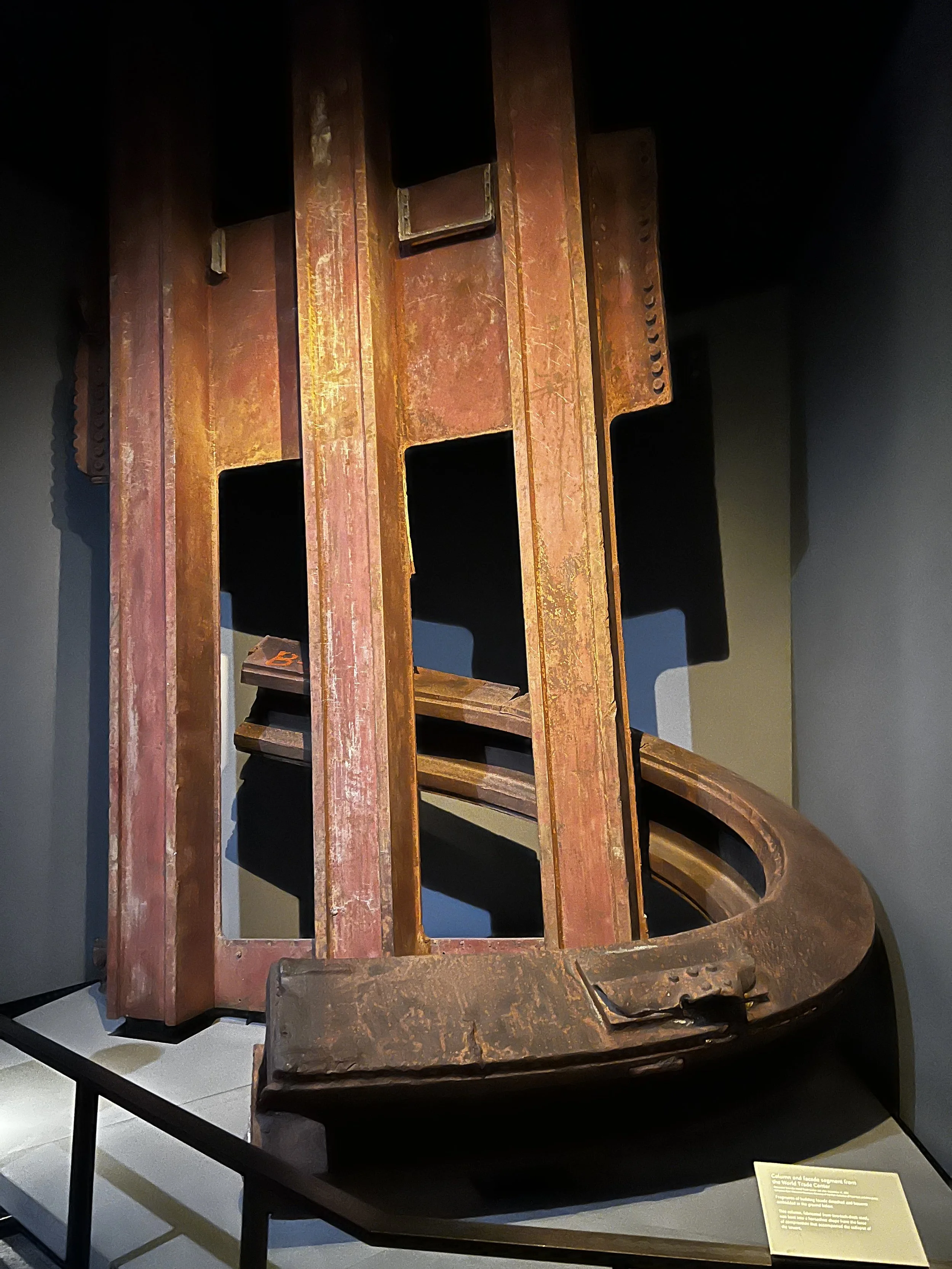
I feel the descent immediately. Down to the burned and crushed fire trucks, last voicemails to family they’d never see again, billowing clouds of ash, various single shoes, a constant cascade of scattered papers, and two-inch-thick steel I-beams unnaturally bent like soft pretzels hot out of the oven. Down into tragedy. September 11, 2011 is one of those moments we living remember exactly where we were and what we were doing when we got the news. It was just after 6 am on a school day, and my mom was visiting us in Oregon. The kids had barely begun to stir. I was taking a first sip of coffee when my Dad called from Texas. Mike was on a flight somewhere between Dallas and Denver. For some reason, his flight was not immediately diverted or grounded until he landed in Denver hours later, completely unaware of the attack. Because of that, we were mesmerized by the display showing all US flight patterns on 9/11 and how they slowly disappeared, leaving a strangely quiet sky.
Glad to escape the details of that day, we burst out onto the bright plaza with two soothing waterfalls pouring into holes where the twin towers used to stand. The names of the dead are not listed alphabetically but gathered in flights, families, work relationships, ladder trucks, or firehouses so they can still be found together. We run our fingers over their names carved into the black granite, feeling each absence under our touch but also the tender care in their gathering after such a horrific crime.
The plaza is leafy under a canopy of over 400 young white oak trees and one pear tree with flowing ribbons in her hair. She was found in the rubble with burned, broken branches and roots. A clean-up worker saw a few leaves and knew “trees don’t give leaves in October unless it is dying and wants to live.” This pear tree was the last living thing pulled from the smoldering debris and ash and she was mortally wounded. New York Parks & Rec workers took her to the Arthur Ross Nursery in the Bronx with hopes of recovery. Eventually, her branches grew smooth and changed from her original bark below. After a decade of care, she is now transplanted into the new plaza where she is thriving and inspiring resilience in those of us who visit or work nearby.
Even 25 years out, and with extra immersion into art for healing (New York City sidewalks, Other Desert Cities, and the Guggenheim), I woke up that night on the 7th floor of a cramped hotel room with narrow hallways and a tin-can lift in a panicked sweat. I was overwhelmed by the deliberate cruelty of the attackers, the deaths of almost 3000 humans, and the traumatized lives of those who survived. Oh, and we who act as witnesses. I paced the floor, tried to catch my breath, prayed, got a drink of water, kept deepening my breaths, prayed more, curled into a ball, and eventually calmed my body enough saying, “Lord, have mercy” to fall asleep again. I’m still not sure just how I managed it.
I woke the next morning, in desperate need of fresh air and good coffee with my feet on ground-level, and pen and paper in hand to catch this fleeting moment. I scratched out this haiku in response to an art exhibit of 2983 watercolor squares of blue to reflect every life lost that day, yet remaining for having been here at all. Written in Lower Manhattan on October 22, 2026.
3000 lively
September shades, severe clear
I-beams bend in grief
A few weeks later, I noticed that part of what had grounded and calmed me in the panicked night was a voice of tenderness and tethering and fierce togetherness. I am feeling my way for words to describe it. It was a person of Invincible Love, a waterfall whose floor I cannot see, but which meets me in my despair. And that darkness, it seems, comes first. Love was already present but now, having looked fear in the mean old eye, I am more open to trusting Love whose arms gather the living, the dead, and the dying. The endless waterfall pours in my chest, and its Love can fill any void, no matter how deep and despairing, made by anyone for any reason. If that sounds too good to be true, well, it is truest true. And consider that I often forget it continually flows. I still feel afraid and find myself living in an untrue story that says Love is out there somewhere and I have to find it, or it can be stopped.
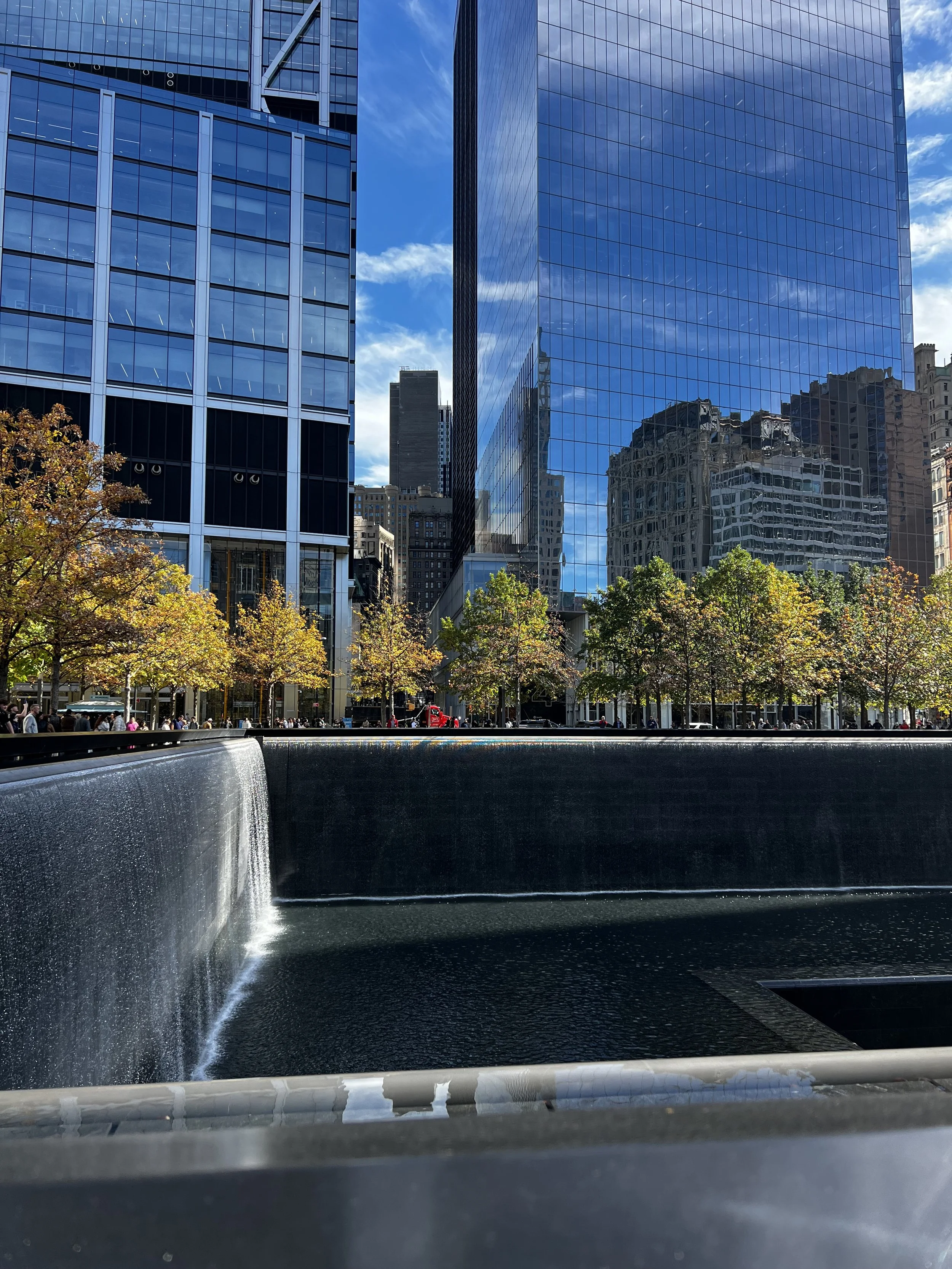
Moment of reflection at one of two waterfalls where one of the World Trade Center Towers used to be. Notice the waterfall into waterfall where absence becomes presence. Also, notice colors of sky and autumn on the far edge.
This line from French Jesuit priest and paleontologist Pierre Teilhard de Chardin written more than one hundred years ago from a bone dig in the Mongolian Desert, though far from my life experience, comes close to my experience that night,
“Throughout my whole life, during every minute of it, the world has been gradually lighting up and blazing before my eyes until it has come to surround me, entirely lit up from within.”
I was searching for light in the darkness, for spaciousness in cramped quarters, for breath in the midst of smoke and ash. I could feel the fray, and the profile of a kind and weathered human face. I was beginning to touch the hem of resilience and rebirth.
Resilience is teaching me her ways of grit and connection, of grounding and flow right at the place where sweet meets bitter, life meets death, and a tender twang of impermanence meets Invincible Love.
Resilience needs to express her grief and her hope. She has both.
Resilience can find hope in a small patch of cold blue sky, scattered ash, a helpless seed, or a single weed pushing through the concrete.
Resilience doesn't know the strange new world she has woken up in, but she shows up anyway.
When her roots are burned, broken, and buried under ash, Resilience sends out a cry for help or any tender shoot.
Despite all appearances, Resilience trusts someone gentle and good will meet her in her broken heartedness.
Resilience takes the long road to healing and accepts help and care along the way.
Resilience practices life and death and resurrection.
Resilience holds terribly beautiful contrasts. She does not return to exactly who she was before. (though she sometimes wants to)